Soak the chickpeas overnight in plenty of cold water with the baking soda.
Bowl
💡Soak in plenty of water, well above what's being soaked: legumes and grains swell and drink water, and whatever sticks out stays hard. Drain well before continuing.
2
Drain, cover with plenty of unsalted water and cook about 1 to 1½ hours, skimming off the foam and skins from time to time, until the chickpeas are very soft and crush easily between your fingers.
ColanderStovePot
💡Fully cooked chickpeas crush between your fingers with no resistance at all. Chickpeas that stay a little firm make a grainy spread, and no amount of tahini will fix it.
💡A pinch of baking soda in the cooking water too, not just in the soak, softens the skins even more.
3
Drain, reserving a cup of the cooking liquid.
Colander
For the Tahini sauce
4
Mix the tahini and lemon juice and season with salt.
5
Gradually add cold water while stirring, until the sauce is smooth, pale and pourable.
💡When you add the first water, the tahini thickens and looks like dough: that's fine. Keep adding water and stirring, and it loosens into a smooth sauce.
6
Mix the tahini, lemon juice, garlic and cumin and season with salt.
To assemble
7
Transfer the tahini sauce to a food processor, add the chickpeas, still warm, and process 3–5 minutes, until it is completely smooth.
Food processor
💡Grind the chickpeas while they are still warm: warm chickpeas grind into a smoother cream than cold ones.
8
Gradually add the water, until the hummus is creamy and airy, and a little thinner than the texture you want: it thickens as it stands.
💡Ice water, not ordinary water, gives hummus an airy, pale texture: the tahini emulsifies with it like mayonnaise.
9
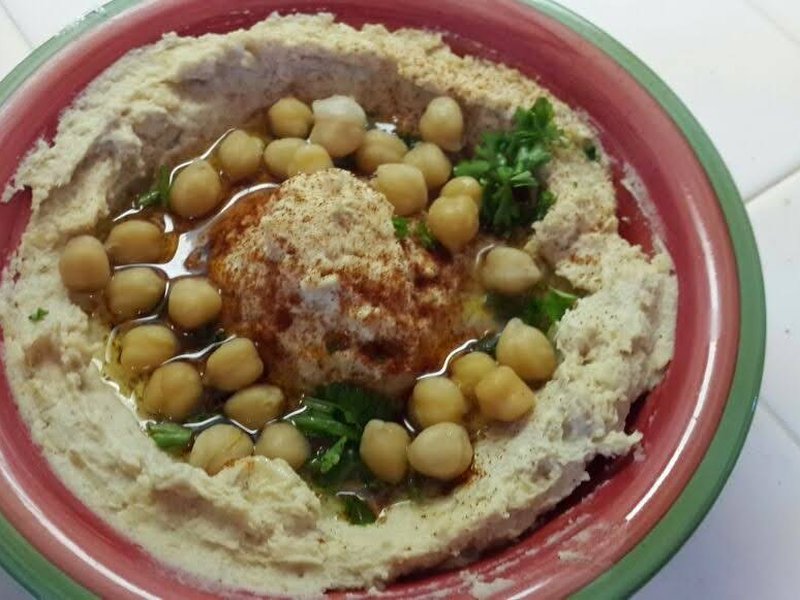
Spread on a plate, make a well in the center and add the olive oil.
654calories
28 gprotein
57 gcarbs
27 gfat
● protein 19%● carbs 39%● fat 42%
Per serving, servings (calculated for this version)
A button hides that part of the recipe, in print too. Another click brings it back. The choice is kept for this recipe.
Olive oil: measured in tbsp in this recipe: 1 tbsp = 14 g · 884 kcal per 100 g · More about Olive oil →
🔧 Tools needed (5) · 🍳 One cooking vessel
Food processor· Also works: Knife (More time and handwork, less even texture) · Electric mini chopper (Small amounts)· 💡 Workaround, changes the dish: Blender (Needs more liquid)
Stove· 💡 Workaround, changes the dish: Portable hot plate (one weaker burner) · Camping gas stove (One burner, outdoors) · Electric pressure cooker (multicooker) (One pot, no real shallow frying)
Pot· Also works: Deep skillet (sauté pan) (less liquid, faster evaporation)· 💡 Workaround, changes the dish: Wok (For quick cooking)
Bowl· Also works: Pot (None)
Colander· Also works: Lid (a lid held slightly open over the sink, you lose a little) · Slotted spoon (for small amounts)
By the steps, as the recipe is built now: another version or addition can change the list.