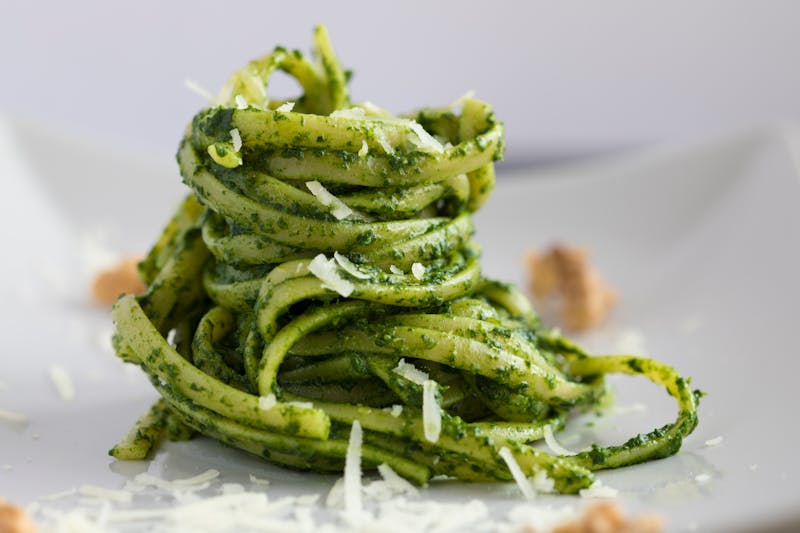
Cook the gluten-free pasta in plenty of boiling salted water (4¼ cups of water and a heaping teaspoon of salt for every 4 oz of gluten-free pasta), following the package directions (taste about 2 minutes early), until al dente.
⚙ Cooking in salted waterStovePot
💡The water should taste like a seasoned soup, not like sea water: a heaping teaspoon of salt per liter. Add the salt once the water is boiling.
2
Reserve cup of the cooking water before draining.
⚙ Saving the cooking waterLadleorMeasuring cup
💡The cooking water is starchy: a spoonful or two binds the sauce to the gluten-free pasta or the gnocchi and makes it glossy.
3
Drain.
Colander
For the Pesto
4
Grind the leaves in a food processor with the nuts, garlic, salt and black pepper.
⚙ Grinding in a Food ProcessorFood processor
💡In a food processor, grind in short pulses and check between pulses: it's easy to go from coarse to paste. (Sesame for tahini, on the other hand, is ground continuously.)
5
Add the Parmesan and grind.
Food processor
6
Add the olive oil in a thin stream, while Tahini, until to a smooth sauce.
⚙ Fat in a Thin StreamFood processor
💡Pesto keeps in the fridge about two weeks in a closed jar, covered with a layer of olive oil. The top layer darkens from the air, and that doesn't mean it has spoiled.
💡The thin stream is everything: fat that goes in too fast can't bind, and the sauce breaks. For mayonnaise and hollandaise, if this happens, start with a fresh yolk and slowly add the broken sauce to it; if the sauce is too thick, thin it with a teaspoon of water.
7
Toss the hot gluten-free pasta with the pesto and a little of the cooking water, until the sauce coats it.
💡Don't heat pesto on the stove: heat turns the basil black. The heat of the gluten-free pasta and the cooking water is enough.
8
Serve immediately with extra Parmesan.
680calories
20 gprotein
74 gcarbs
33 gfat
● protein 12%● carbs 44%● fat 44%
Per serving (162 g), of 4 servings
For the Cooked pasta · For the Pesto ·
A button hides that part of the recipe, in print too. Another click brings it back. The choice is kept for this recipe.
⚖ About the ingredients
Pasta: measured in pieces: one ≈ 20 g · 371 kcal per 100 g · More about Pasta →
Walnuts: measured in cup in this recipe: 1 cup = 117 g · 654 kcal per 100 g · More about Walnuts →
Garlic: measured in pieces: one ≈ 5 g · 149 kcal per 100 g · More about Garlic →
Parmesan cheese: measured in cup in this recipe: 1 cup = 100 g · 367 kcal per 100 g · More about Parmesan cheese →
Olive oil: measured in cup in this recipe: 1 cup = 216 g · 884 kcal per 100 g · More about Olive oil →
Salt: measured in tsp in this recipe: 1 tsp = 6 g · 0 kcal per 100 g · More about Salt →
Black pepper: measured in tsp in this recipe: 1 tsp = 2.4 g · 251 kcal per 100 g · More about Black pepper →
🔧 Tools needed (5) · 🍳 One cooking vessel
Food processor· Also works: Knife (More time and handwork, less even texture) · Electric mini chopper (Small amounts)· 💡 Workaround, changes the dish: Blender (Needs more liquid)
Stove· 💡 Workaround, changes the dish: Portable hot plate (one weaker burner) · Camping gas stove (One burner, outdoors) · Electric pressure cooker (multicooker) (One pot, no real shallow frying)
Pot· Also works: Deep skillet (sauté pan) (less liquid, faster evaporation)· 💡 Workaround, changes the dish: Wok (For quick cooking)
Colander· Also works: Lid (a lid held slightly open over the sink, you lose a little) · Slotted spoon (for small amounts)
Ladle or Measuring cup· one of them
By the steps, as the recipe is built now: another version or addition can change the list.