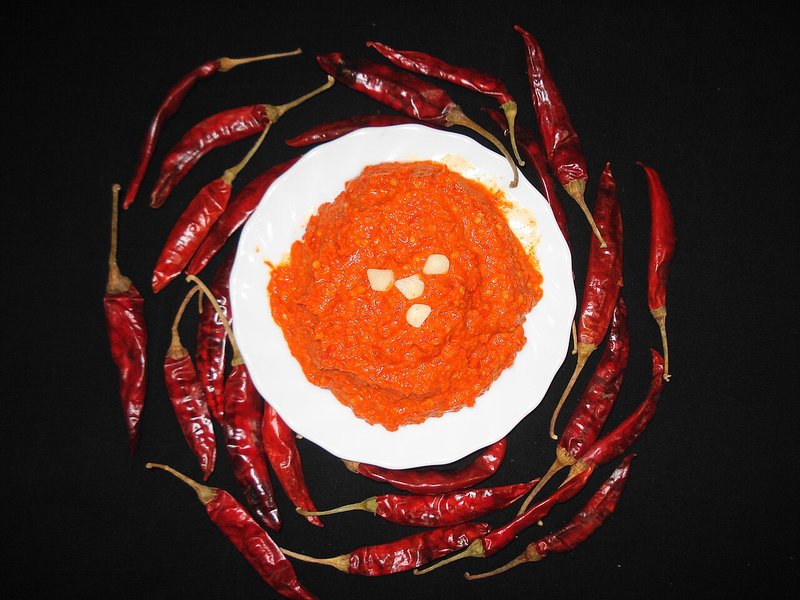
Arrange the peppers and hot peppers on a baking sheet.
Baking pan
2
Roast the peppers and hot peppers whole in a hot oven (220°C / 430°F) 25–40 minutes, turning, until the skin is blackened and the flesh completely soft.
⚙ Oven roastingOvenBakeware
💡Give it room in the pan: crowded vegetables steam instead of browning.
3
Transfer to a bowl, cover tightly and leave 10–15 minutes.
Bowl
💡The steam in the covered container separates the skin from the flesh, so it comes off easily. Don't rinse under water: the smoky flavor washes away with it.
4
Peel off the charred skin, remove the stem and seeds from the peppers and the hot peppers and drain off the liquid.
Colander
To assemble
5
Toast the cumin, cilantro and caraway in a dry skillet over medium heat 1–2 minutes, stirring, until fragrant.
⚙ Dry-Pan ToastingStoveFrying pan
💡Toasting whole spices in a dry pan releases their oils: the aroma intensifies, and they are ground only after toasting.
💡Toast over medium heat and keep things moving: nuts, pine nuts and spices go from toasted to burnt in seconds. Transfer to a plate right away, since the hot pan keeps toasting.
6
Grind the peppers in a food processor with the garlic, cumin, cilantro, caraway and salt.
⚙ Grinding in a Food ProcessorFood processor
💡In a food processor, grind in short pulses and check between pulses: it's easy to go from coarse to paste. (Sesame for tahini, on the other hand, is ground continuously.)
7
Add the oil in a thin stream, while Tahini, until a smooth paste.
⚙ Fat in a Thin StreamFood processor
💡The thin stream is everything: fat that goes in too fast can't bind, and the sauce breaks. For mayonnaise and hollandaise, if this happens, start with a fresh yolk and slowly add the broken sauce to it; if the sauce is too thick, thin it with a teaspoon of water.
8
Transfer to a jar and cover with a layer of oil about a centimeter deep. Store in the fridge, and for long storage freeze in small jars.
💡The layer of oil on top seals the harissa from the air, so it doesn't sour or grow mold.
146calories
3 gprotein
14 gcarbs
8 gfat
● protein 10%● carbs 40%● fat 50%
Per serving (210 g), of 4 servings
For the Roasted Vegetables · To assemble ·
A button hides that part of the recipe, in print too. Another click brings it back. The choice is kept for this recipe.
Garlic: measured in pieces: one ≈ 5 g · 149 kcal per 100 g · More about Garlic →
Cumin: measured in tsp in this recipe: 1 tsp = 2.1 g · 375 kcal per 100 g · More about Cumin →
Coriander seeds: measured in tsp in this recipe: 1 tsp = 1 g · 298 kcal per 100 g · More about Coriander seeds →
Caraway: measured in tsp in this recipe: 1 tsp = 5 g · 333 kcal per 100 g · More about Caraway →
Olive oil: measured in tbsp in this recipe: 1 tbsp = 14 g · 884 kcal per 100 g · More about Olive oil →
Salt: measured in tbsp in this recipe: 1 tbsp = 18 g · 0 kcal per 100 g · More about Salt →
🔧 Tools needed (7) · 🍳 2 cooking vessels
Food processor· Also works: Knife (More time and handwork, less even texture) · Electric mini chopper (Small amounts)· 💡 Workaround, changes the dish: Blender (Needs more liquid)
Oven· 💡 Workaround, changes the dish: Toaster oven (Fits one small pan; good for small batches) · Air fryer (Small batches only, no runny batters) · Pot (Only for covered stews on the stovetop, no browning on top)
Stove· 💡 Workaround, changes the dish: Portable hot plate (one weaker burner) · Camping gas stove (One burner, outdoors) · Electric pressure cooker (multicooker) (One pot, no real shallow frying)
Frying pan· Also works: Wok (None)· 💡 Workaround, changes the dish: Pot (High sides, slow evaporation and weak browning)
Baking pan· Also works: Glass / ovenproof baking dish (None) · Disposable pan (None)
Bowl· Also works: Pot (None)
Colander· Also works: Lid (a lid held slightly open over the sink, you lose a little) · Slotted spoon (for small amounts)
By the steps, as the recipe is built now: another version or addition can change the list.