Dissolve the yeast and the sugar in the lukewarm water and leave about 10 minutes, until the mixture foams.
💡If the mixture doesn't foam in that time, the yeast is no longer active, or the water was too hot. Start over with fresh yeast and body-temperature water.
2
Mix the flour and salt in a large bowl.
Bowl
3
Add the yeast mixture and the olive oil and Knead about 10 minutes, until the dough is smooth, pliable and doesn't stick to your hands.
⚙ KneadingBowlStand mixer
💡For yeast dough, use the windowpane test: a small piece stretches into a thin, translucent sheet without tearing, and that's the sign the kneading is done. Add flour only by the tablespoon, and only if the dough is still sticky after a few minutes: too much flour makes a tough dough.
4
Spread the oil in a bowl, put the dough in it, cover and Let rise 1 hour in a warm place, until the dough doubles in size.
⚙ ProofingPlastic wraporKitchen towel
💡Let rise in a warm, draft-free spot. The dough is ready when it has doubled, and a gentle finger press leaves a dent that fills back slowly; if it springs right back, wait longer.
5
Shape the dough into a ball and place on a baking sheet lined with floured parchment paper.
Baking panParchment paper
6
Let rise another 30 minutes.
⚙ ProofingPlastic wraporKitchen towel
7
Preheat the oven to 220°C (430°F) and place a pan of water on its bottom rack.
⚙ Preheating the OvenOven
💡Put things in the oven only once it's reached temperature, after the heating light has gone off: an oven that hasn't reached temperature changes baking times, and the bake burns outside or stays underbaked.
8
Score an X on top of the loaf with a sharp knife.
Knife
💡The score decides where the bread opens in the oven: without it, the loaf bursts at a random spot on the side.
9
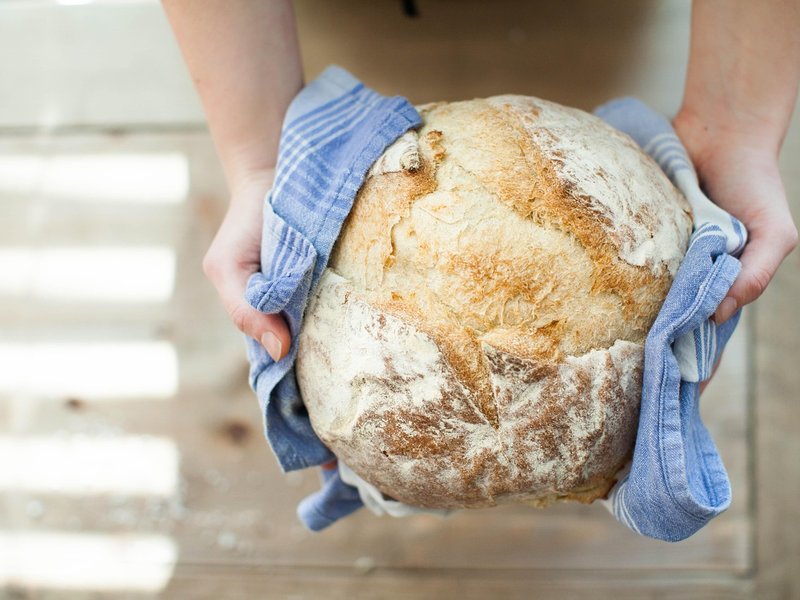
Bake 25 minutes, until the bread has risen and the crust starts to turn golden. Remove the water pan and bake 20 more minutes, until the bread is deep brown and sounds hollow when tapped on the bottom.
⚙ BakingOvenBaking pan
💡The steam from the water pan keeps the crust soft in the first minutes, giving the bread time to rise fully; without the water, the crust dries and turns crisp.
💡Check by the cue (until…), not just the clock: every oven bakes a little differently.
267calories
7 gprotein
47 gcarbs
5 gfat
● protein 11%● carbs 73%● fat 16%
Per serving (106 g), of 8 servings
For the Dough base ·
A button hides that part of the recipe, in print too. Another click brings it back. The choice is kept for this recipe.
Sugar: measured in tsp in this recipe: 1 tsp = 4.2 g · 387 kcal per 100 g · More about Sugar →
Salt: measured in tsp in this recipe: 1 tsp = 6 g · 0 kcal per 100 g · More about Salt →
Olive oil: measured in tbsp in this recipe: 1 tbsp = 14 g · 884 kcal per 100 g · More about Olive oil →
🔧 Tools needed (4) · 🍳 One cooking vessel
Oven· 💡 Workaround, changes the dish: Toaster oven (Fits one small pan; good for small batches) · Air fryer (Small batches only, no runny batters) · Pot (Only for covered stews on the stovetop, no browning on top)
Baking pan· Also works: Glass / ovenproof baking dish (None) · Disposable pan (None)
Knife· Also works: Food processor (Fast, less control over size) · Kitchen shears (For herbs/dough)
Bowl· Also works: Pot (None)
🧻 Consumables: Parchment paper · Kitchen towel or Plastic wrap
Helps, not needed: Stand mixer
By the steps, as the recipe is built now: another version or addition can change the list.