Wash the tomatoes, remove the cores and quarter each tomato.
KnifeCutting board
2
Put the tomatoes, the salt and half of the olive oil in a wide pot, cover and cook over medium heat about 20 minutes, until the tomatoes soften and release their liquid.
StoveWide, shallow pot
3
Pass the tomatoes and their liquid through a food mill or sieve and return the purée to the pot: the skins and seeds stay behind.
Food millorFine sieve
4
Cook uncovered about an hour at a lively simmer, stirring now and then, until the purée reduces by half.
StoveWooden spoon
💡The paste burns easily as it dries: stir and scrape the bottom and edges, and once it is thick, don't walk away.
5
Preheat the oven to 110°C (230°F).
Oven
💡Put things in the oven only once it's reached temperature, after the heating light has gone off: an oven that hasn't reached temperature changes baking times, and the bake burns outside or stays underbaked.
6
Grease a wide baking dish with the rest of the olive oil and pour in the purée in a thin layer. Dry in the oven about 3 hours, stirring and scraping the edges every 30 minutes, until the paste is thick, sticky and brick red.
OvenBaking sheetSilicone spatula
7
Let the paste cool.
Jar
For the Mashed Potatoes
8
Preheat the oven to 200°C (390°F).
Oven
9
Peel the potatoes and cut into similar-size pieces.
PeelerKnifeCutting board
10
Cook the potatoes in a pot with cold salted water to cover by about 2 cm, 20–25 minutes from the boil, until a fork goes in easily.
StovePot
11
Drain and return them to the hot pot over low heat for a minute: the excess moisture evaporates.
ColanderStove
12
Heat the milk and butter to just below boiling.
StoveSmall saucepan
💡The milk and butter go in hot and in small portions: cold liquid cools the mash, and too much liquid makes it runny.
13
Mash the potatoes with a hand masher, gradually adding the milk and butter, until there are no lumps.
Masher
💡Mash by hand, not in a food processor or blender: the blades release starch and the mash turns gluey.
14
Season with salt and stir briefly.
For the Meat sauce
15
Heat the oil in a pot over medium heat.
StovePot
16
Add the onion and carrot and fry 5–8 minutes, stirring now and then, until the onion is soft and translucent and starts to turn golden at the edges. If it browns too fast, lower the heat.
Stove
💡Add by cooking time: what needs long (onion, carrot, meat) goes in first, and what burns fast (garlic, dry spices) goes in last, only until fragrant.
17
Raise the heat to medium-high and add the meat. Press it flat over the bottom and leave it for 2–3 minutes without stirring, until a brown crust forms.
Stove
💡Brown ground beef in the pot without pressing it: leave it as one 'cake' for a few minutes until a brown crust forms, then break it into chunks. Deep browning = deep flavor.
18
Break it up with a wooden spoon and fry for 5–7 more minutes, stirring, until no pink is left and the meat browns.
StoveWooden spoon
19
Add the tomato paste to the meat and stir 1 minute, until it darkens a little.
💡Fry the tomato paste with the meat for a minute before the liquids: it caramelizes lightly, loses its sourness and deepens the sauce.
20
Add the beef stock and peas and bring to a boil.
Stove
21
Serve hot 0.
StoveLid
💡The slower the sauce cooks, the thicker it gets and the better the flavors blend. 20–30 minutes make a quick meat sauce; an hour and a half to two hours over low heat make a rich Bolognese.
💡A gentle simmer, not a boil: a hard boil dries the food out and clouds it, a slow simmer cooks it evenly.
22
Transfer the meat mixture to a baking dish and level it.
Baking pan
23
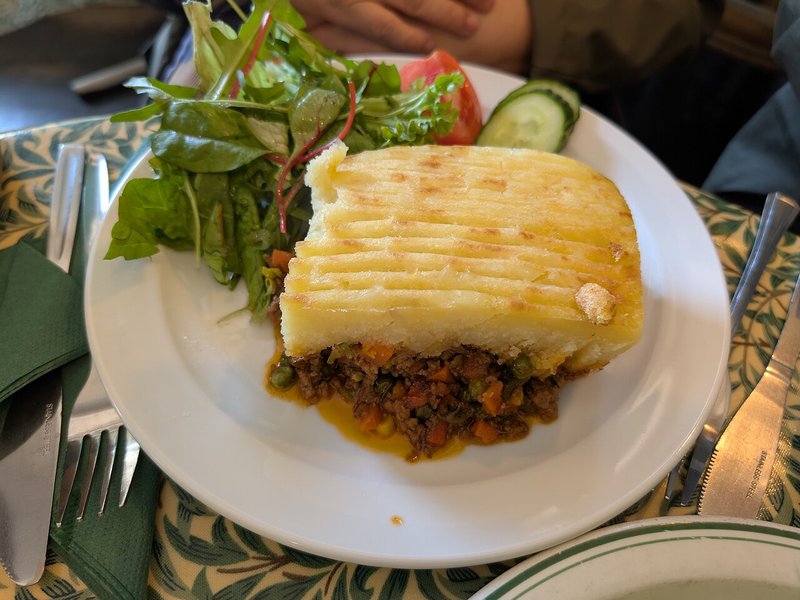
Cover the meat with a layer of mashed potatoes and furrow the top with a fork.
💡Spread the mash over the meat carefully, so the layers don't mix.
24
Bake 25 minutes, until the mash turns golden.
OvenBaking pan
💡Check by the cue (until…), not just the clock: every oven bakes a little differently.
855calories
35 gprotein
56 gcarbs
53 gfat
● protein 17%● carbs 27%● fat 57%
Per serving, servings (calculated for this version)
A button hides that part of the recipe, in print too. Another click brings it back. The choice is kept for this recipe.
⚖ About the ingredients
Potatoes: measured in pieces: one ≈ 170 g · 77 kcal per 100 g · More about Potatoes →
Milk: measured in cup in this recipe: 1 cup = 244 g · 60 kcal per 100 g · More about Milk →
Butter: measured in tbsp in this recipe: 1 tbsp = 14 g · 717 kcal per 100 g · More about Butter →
Salt: measured in tsp in this recipe: 1 tsp = 6 g · 0 kcal per 100 g · More about Salt →
Onion: measured in pieces: one ≈ 117 g · 40 kcal per 100 g · More about Onion →
Carrots: measured in pieces: one ≈ 62 g · 41 kcal per 100 g · More about Carrots →
Beef stock: measured in cup in this recipe: 1 cup = 240 g · 12 kcal per 100 g · More about Beef stock →
Tomato paste: measured in tbsp in this recipe: 1 tbsp = 16 g · 109 kcal per 100 g · More about Tomato paste →
Green peas: measured in cup in this recipe: 1 cup = 178 g · 81 kcal per 100 g · More about Green peas →
🔧 Tools needed (12) · 🍳 3 cooking vessels
Oven· 💡 Workaround, changes the dish: Toaster oven (Fits one small pan; good for small batches) · Air fryer (Small batches only, no runny batters) · Pot (Only for covered stews on the stovetop, no browning on top)
Stove· 💡 Workaround, changes the dish: Portable hot plate (one weaker burner) · Camping gas stove (One burner, outdoors) · Electric pressure cooker (multicooker) (One pot, no real shallow frying)