Dissolve the yeast and tbsp of the sugar in the lukewarm milk and leave about 10 minutes, until the mixture foams.
💡If the mixture doesn't foam in that time, the yeast is no longer active, or the water was too hot. Start over with fresh yeast and body-temperature water.
2
Mix the flour, rest of the sugar and salt in a large bowl.
Bowl
3
Add the yeast mixture, the egg and the butter and Knead about 10 minutes, until the dough is smooth, pliable and doesn't stick to your hands.
⚙ KneadingBowlStand mixer
💡For yeast dough, use the windowpane test: a small piece stretches into a thin, translucent sheet without tearing, and that's the sign the kneading is done. Add flour only by the tablespoon, and only if the dough is still sticky after a few minutes: too much flour makes a tough dough.
4
Cover and Let rise 1 hour in a warm place, until the dough doubles in size.
⚙ ProofingPlastic wraporKitchen towel
💡Let rise in a warm, draft-free spot. The dough is ready when it has doubled, and a gentle finger press leaves a dent that fills back slowly; if it springs right back, wait longer.
To assemble
5
Roll out the dough on a floured surface to 1 cm thick and cut out 7 cm rounds.
⚙ Rolling Out DoughRolling pinCookie cutter
💡Roll from the center outward and give the dough a quarter turn between rolls: this keeps it even in thickness and stops it sticking to the counter. If it springs back, cover for 10–15 minutes and try again.
6
Arrange the rounds on a baking sheet lined with parchment paper, cover with a towel and Let rise another 30 minutes.
⚙ ProofingPlastic wraporKitchen towelKitchen towelBaking pan
💡The second rise, after cutting, is what makes an airy doughnut: a round that didn't rise again comes out dense and greasy. On a square of paper it goes into the oil without losing its shape.
7
Heat the oil in a wide pot to 180°C (355°F) and lower the rounds into the oil. Fry 2–3 minutes per side, until a pale ring forms around the middle, and transfer to paper towels.
💡Oil that's too hot browns the outside before the center cooks: fry at a measured temperature, and a lid on the first side steams the dough and gives the pale ring.
💡Keep the oil at 170–180°C (340–355°F): too cold, and the food soaks up oil; too hot, and it browns outside before the inside cooks. Without a thermometer, dip the tip of a wooden spoon in the oil: when medium bubbles form around it right away, the oil is hot enough.
💡Don't overload the oil: every piece that goes in cools it down. Fry one piece as a test, then the rest in several batches, and transfer to paper towels.
8
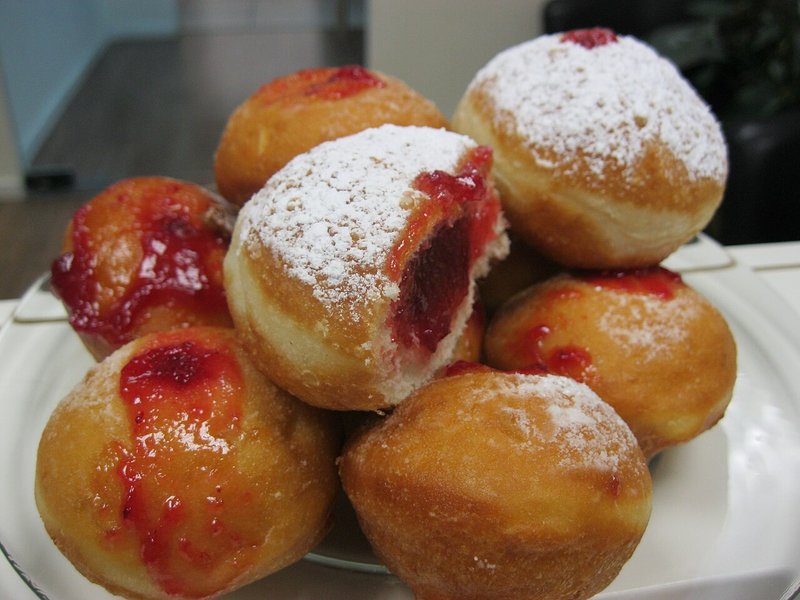
Dust the powdered sugar over the top.
Sifter
290calories
7 gprotein
42 gcarbs
10 gfat
● protein 10%● carbs 59%● fat 31%
Per serving (99 g), of 8 servings
For the Dough base · To assemble ·
A button hides that part of the recipe, in print too. Another click brings it back. The choice is kept for this recipe.
⚖ About the ingredients
White flour: measured in cup in this recipe: 1 cup = 125 g · 364 kcal per 100 g · More about White flour →
Milk: measured in cup in this recipe: 1 cup = 244 g · 60 kcal per 100 g · More about Milk →
Dry yeast: measured in tsp in this recipe: 1 tsp = 4 g · 325 kcal per 100 g · More about Dry yeast →
White sugar: measured in tbsp in this recipe: 1 tbsp = 15 g · 387 kcal per 100 g · More about White sugar →
Salt: measured in tsp in this recipe: 1 tsp = 6 g · 0 kcal per 100 g · More about Salt →
Eggs: measured in pieces: one ≈ 50 g · 143 kcal per 100 g · More about Eggs →
Softened butter: measured in tbsp in this recipe: 1 tbsp = 14 g · 717 kcal per 100 g · More about Softened butter →
Stove· 💡 Workaround, changes the dish: Portable hot plate (one weaker burner) · Camping gas stove (One burner, outdoors) · Electric pressure cooker (multicooker) (One pot, no real shallow frying)
Wide, shallow pot· Also works: Deep skillet (sauté pan) (None)· 💡 Workaround, changes the dish: Pot (Layers instead of a single layer)
Baking pan· Also works: Glass / ovenproof baking dish (None) · Disposable pan (None)