Dissolve the yeast and the sugar in the lukewarm water and leave about 10 minutes, until the mixture foams.
💡If the mixture doesn't foam in that time, the yeast is no longer active, or the water was too hot. Start over with fresh yeast and body-temperature water.
2
Mix the flour and salt in a large bowl.
Bowl
3
Add the yeast mixture and the olive oil and Knead about 8–10 minutes, until the dough is smooth, pliable and doesn't stick to your hands.
⚙ KneadingBowlStand mixer
💡For yeast dough, use the windowpane test: a small piece stretches into a thin, translucent sheet without tearing, and that's the sign the kneading is done. Add flour only by the tablespoon, and only if the dough is still sticky after a few minutes: too much flour makes a tough dough.
4
Cover and Let rise about an hour in a warm place, until the dough doubles in size.
⚙ ProofingPlastic wraporKitchen towel
💡Let rise in a warm, draft-free spot. The dough is ready when it has doubled, and a gentle finger press leaves a dent that fills back slowly; if it springs right back, wait longer.
To assemble
5
Preheat the oven to 220°C (430°F).
⚙ Preheating the OvenOven
💡Put things in the oven only once it's reached temperature, after the heating light has gone off: an oven that hasn't reached temperature changes baking times, and the bake burns outside or stays underbaked.
6
In a bowl, mix the mozzarella, Parmesan, ricotta, garlic, parsley and black pepper for the filling.
Bowl
7
Roll out the dough into two rounds.
⚙ Rolling Out DoughRolling pin
💡Let the pizza dough rise for 24 hours in the fridge (a long cold rise) — the dough develops a deeper flavor and an airy texture with big bubbles.
💡Roll from the center outward and give the dough a quarter turn between rolls: this keeps it even in thickness and stops it sticking to the counter. If it springs back, cover for 10–15 minutes and try again.
8
Put half the filling on half of each round.
9
Fold the empty half over the filling and press the edges firmly to seal.
💡Leave 2 cm clear at the edge of the filled half and don't overfill: that way the edges seal well and the filling doesn't escape during baking.
10
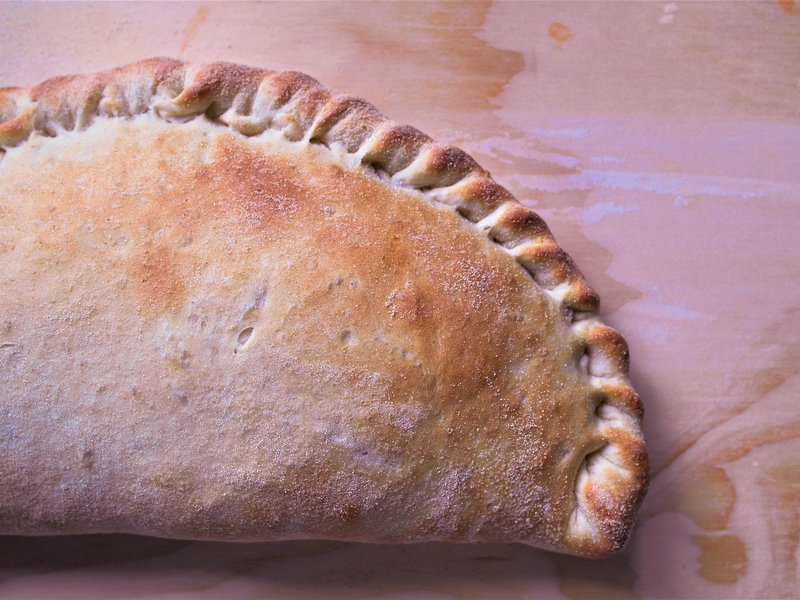
Transfer to a pan lined with parchment paper, brush with olive oil and bake 20–25 minutes, until the calzone is golden.
Baking panParchment paperPastry brushOven
343calories
14 gprotein
37 gcarbs
15 gfat
● protein 17%● carbs 44%● fat 39%
Per serving (128 g), of 8 servings
For the Dough base · To assemble ·
A button hides that part of the recipe, in print too. Another click brings it back. The choice is kept for this recipe.
⚖ About the ingredients
White flour: measured in cup in this recipe: 1 cup = 125 g · 364 kcal per 100 g · More about White flour →
Water: measured in cup in this recipe: 1 cup = 240 g · 0 kcal per 100 g · More about Water →
Black pepper: measured in tsp in this recipe: 1 tsp = 2.4 g · 251 kcal per 100 g · More about Black pepper →
Garlic: measured in pieces: one ≈ 5 g · 149 kcal per 100 g · More about Garlic →
Fresh parsley: measured in tbsp in this recipe: 1 tbsp = 12 g · 36 kcal per 100 g · More about Fresh parsley →
🔧 Tools needed (5) · 🍳 One cooking vessel
Oven· 💡 Workaround, changes the dish: Toaster oven (Fits one small pan; good for small batches) · Air fryer (Small batches only, no runny batters) · Pot (Only for covered stews on the stovetop, no browning on top)
Baking pan· Also works: Glass / ovenproof baking dish (None) · Disposable pan (None)
Pastry brush· Also works: Spoon / teaspoon (regular) (Spread with the back of a spoon, less even) · Paper towels (Paper towel dipped in oil)
Rolling pin· Also works: Glass (for drinking/serving) (Bottle/glass, less even rolling) · Pasta machine (For pasta dough)
Bowl· Also works: Pot (None)
🧻 Consumables: Parchment paper · Kitchen towel or Plastic wrap
Helps, not needed: Stand mixer
By the steps, as the recipe is built now: another version or addition can change the list.