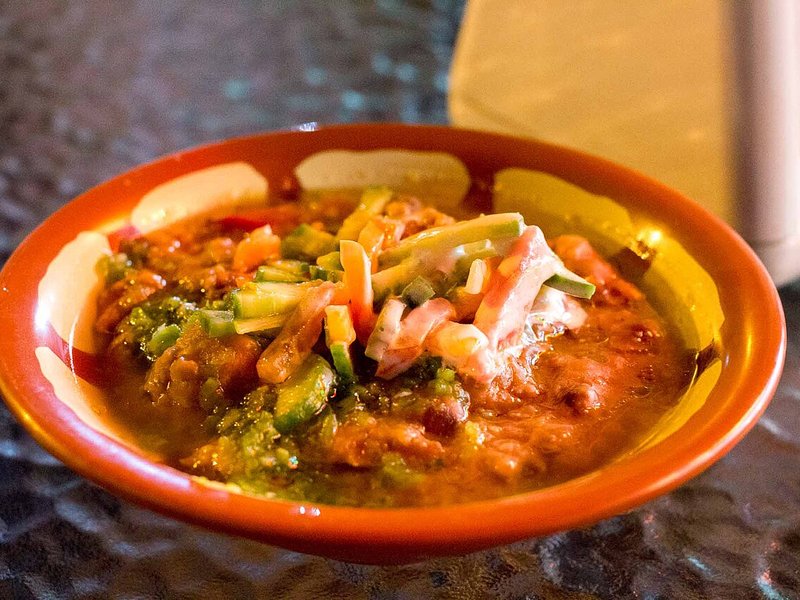
Mix the flour, yeast, sugar and salt in a large bowl.
Bowl
2
Add the lukewarm water and olive oil and Knead about 10 minutes, until the dough is smooth, pliable and doesn't stick to your hands.
BowlStand mixer
💡For yeast dough, use the windowpane test: a small piece stretches into a thin, translucent sheet without tearing, and that's the sign the kneading is done. Add flour only by the tablespoon, and only if the dough is still sticky after a few minutes: too much flour makes a tough dough.
3
Cover and Let rise about an hour in a warm place, until the dough doubles in size.
Plastic wraporKitchen towel
💡Let rise in a warm, draft-free spot. The dough is ready when it has doubled, and a gentle finger press leaves a dent that fills back slowly; if it springs right back, wait longer.
4
Preheat the oven to 250°C (480°F), with an upside-down baking sheet inside, for at least half an hour.
Oven
💡Put things in the oven only once it's reached temperature, after the heating light has gone off: an oven that hasn't reached temperature changes baking times, and the bake burns outside or stays underbaked.
5
Divide the dough into 10 balls and roll each ball into a circle about ½ cm thick.
Rolling pin
💡Don't roll too thin: in a round half a centimeter thick or more, the steam in the dough puffs it into a pocket; a round that's too thin dries into a cracker.
💡Dough that springs back needs rest: cover the balls for 10 minutes and the gluten relaxes.
6
Cover the rounds with a towel and let rest 15 minutes.
Kitchen towel
7
Bake on the hot baking sheet, 3–4 pitas at a time, 3–5 minutes, until the pitas puff into a pocket and take on a little color.
OvenBaking sheet
💡Full heat and a scorching-hot baking sheet are what make the pocket: in an oven that isn't hot enough, the pita bakes flat.
💡Check by the cue (until…), not just the clock: every oven bakes a little differently.
8
Wrap immediately in a towel, so the pitas stay soft.
Kitchen towel
For the Boiled Egg
9
Bring a pot of water to a boil, deep enough to cover the egg by about 2 cm.
StovePot
10
Gently lower the egg into it with a spoon.
11
Turn down the heat slightly and simmer 10–11 minutes.
Stove
💡A gentle simmer, not a boil: a hard boil dries the food out and clouds it, a slow simmer cooks it evenly.
12
Transfer immediately to a bowl of ice water for 5–10 minutes, and peel from the wide end.
Ice bath
💡Cold water right after cooking stops the cooking and separates the membrane from the white: peeling is easy, and the yolk doesn't turn gray.
To assemble
13
Drain the ful, transfer to a pot with the water, add the garlic, cumin and salt and cook for 10 minutes.
ColanderStovePot
14
Mash some of the fava beans with a fork, for a semi-smooth texture.
15
Add the lemon juice and toss.
16
Transfer onto a plate and top with the tahini, olive oil and parsley.
17
Serve with the hard-boiled egg and pita.
433calories
23 gprotein
53 gcarbs
15 gfat
● protein 21%● carbs 49%● fat 30%
Per serving, servings (calculated for this version)
A button hides that part of the recipe, in print too. Another click brings it back. The choice is kept for this recipe.
⚖ About the ingredients
Eggs: measured in pieces: one ≈ 50 g · 143 kcal per 100 g · More about Eggs →
Stove· 💡 Workaround, changes the dish: Portable hot plate (one weaker burner) · Camping gas stove (One burner, outdoors) · Electric pressure cooker (multicooker) (One pot, no real shallow frying)
Pot· Also works: Deep skillet (sauté pan) (less liquid, faster evaporation)· 💡 Workaround, changes the dish: Wok (For quick cooking)
Colander· Also works: Lid (a lid held slightly open over the sink, you lose a little) · Slotted spoon (for small amounts)
Ice bath· 💡 Workaround, changes the dish: Refrigerator (Much longer, less green color)
By the steps, as the recipe is built now: another version or addition can change the list.