Mix the flour, yeast, sugar and salt in a large bowl.
Bowl
2
Add the lukewarm water and olive oil and Knead about 10 minutes, until the dough is smooth, pliable and doesn't stick to your hands.
BowlStand mixer
💡For yeast dough, use the windowpane test: a small piece stretches into a thin, translucent sheet without tearing, and that's the sign the kneading is done. Add flour only by the tablespoon, and only if the dough is still sticky after a few minutes: too much flour makes a tough dough.
3
Cover and Let rise about an hour in a warm place, until the dough doubles in size.
Plastic wraporKitchen towel
💡Let rise in a warm, draft-free spot. The dough is ready when it has doubled, and a gentle finger press leaves a dent that fills back slowly; if it springs right back, wait longer.
4
Preheat the oven to 250°C (480°F), with an upside-down baking sheet inside, for at least half an hour.
Oven
💡Put things in the oven only once it's reached temperature, after the heating light has gone off: an oven that hasn't reached temperature changes baking times, and the bake burns outside or stays underbaked.
5
Divide the dough into 10 balls and roll each ball into a circle about ½ cm thick.
Rolling pin
💡Don't roll too thin: in a round half a centimeter thick or more, the steam in the dough puffs it into a pocket; a round that's too thin dries into a cracker.
💡Dough that springs back needs rest: cover the balls for 10 minutes and the gluten relaxes.
6
Cover the rounds with a towel and let rest 15 minutes.
Kitchen towel
7
Bake on the hot baking sheet, 3–4 pitas at a time, 3–5 minutes, until the pitas puff into a pocket and take on a little color.
OvenBaking sheet
💡Full heat and a scorching-hot baking sheet are what make the pocket: in an oven that isn't hot enough, the pita bakes flat.
💡Check by the cue (until…), not just the clock: every oven bakes a little differently.
8
Wrap immediately in a towel, so the pitas stay soft.
Kitchen towel
For the Hummus
9
Soak the chickpeas overnight in plenty of cold water with the baking soda.
Bowl
💡Soak in plenty of water, well above what's being soaked: legumes and grains swell and drink water, and whatever sticks out stays hard. Drain well before continuing.
10
Drain, cover with plenty of unsalted water and cook about 1 to 1½ hours, skimming off the foam and skins from time to time, until the chickpeas are very soft and crush easily between your fingers.
ColanderStovePot
💡Fully cooked chickpeas crush between your fingers with no resistance at all. Chickpeas that stay a little firm make a grainy spread, and no amount of tahini will fix it.
💡A pinch of baking soda in the cooking water too, not just in the soak, softens the skins even more.
11
Drain, reserving a cup of the cooking liquid.
Colander
12
Grind the sesame seeds in a powerful blender about 3 minutes, until smooth paste forms.
Blender
💡At first the sesame looks like dry crumbs: keep grinding, scraping down the sides, and after a few minutes it releases its oil and turns liquid.
💡In a food processor, grind in short pulses and check between pulses: it's easy to go from coarse to paste. (Sesame for tahini, on the other hand, is ground continuously.)
13
Taste and adjust the seasoning.
14
Mix the tahini, lemon juice and garlic and season with salt.
15
Transfer the tahini sauce to a food processor, add the chickpeas, still warm, and process 3–5 minutes, until it is completely smooth.
Food processor
💡Grind the chickpeas while they are still warm: warm chickpeas grind into a smoother cream than cold ones.
16
Gradually add the water, until the hummus is creamy and airy, and a little thinner than the texture you want: it thickens as it stands.
💡Ice water, not ordinary water, gives hummus an airy, pale texture: the tahini emulsifies with it like mayonnaise.
17
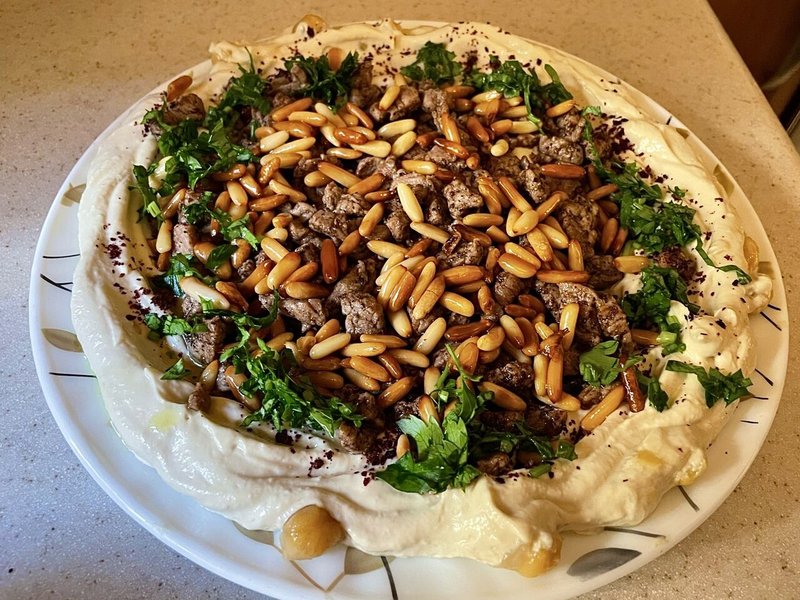
Spread on a plate, make a well in the center and add the paprika and parsley.
For the Hot Topping
18
Heat the butter in a wide pan over medium heat.
StoveFrying pan
19
Add the onion and fry 5–8 minutes, stirring now and then, until the onion is soft and translucent and starts to turn golden at the edges. If it browns too fast, lower the heat.
Stove
💡Add by cooking time: what needs long (onion, carrot, meat) goes in first, and what burns fast (garlic, dry spices) goes in last, only until fragrant.
20
Raise the heat to medium-high and add the meat. Press it flat over the bottom and leave it for 2–3 minutes without stirring, until a brown crust forms.
Stove
💡Brown ground beef in the pot without pressing it: leave it as one 'cake' for a few minutes until a brown crust forms, then break it into chunks. Deep browning = deep flavor.
21
Break it up with a wooden spoon and fry for 5–7 more minutes, stirring, until no pink is left and the meat browns.
StoveWooden spoon
22
Add the baharat and fry another 1–2 minutes, stirring, until fragrant.
Stove
To assemble
23
Toast the pine nuts in a dry skillet over medium heat 2–3 minutes, stirring, until they start to turn golden.
StoveFrying pan
💡Toast over medium heat and keep things moving: nuts, pine nuts and spices go from toasted to burnt in seconds. Transfer to a plate right away, since the hot pan keeps toasting.
24
Place the hot topping in the center of the hummus, sprinkle the pine nuts over it and serve with warm pita.
1342calories
51 gprotein
136 gcarbs
57 gfat
● protein 16%● carbs 43%● fat 41%
Per serving, servings (calculated for this version)
A button hides that part of the recipe, in print too. Another click brings it back. The choice is kept for this recipe.
⚖ About the ingredients
Chickpeas: measured in cup in this recipe: 1 cup = 200 g · 364 kcal per 100 g · More about Chickpeas →
Baking soda: measured in tsp in this recipe: 1 tsp = 5 g · 0 kcal per 100 g · More about Baking soda →
Raw tahini: measured in cup in this recipe: 1 cup = 240 g · 665 kcal per 100 g · More about Raw tahini →
Lemon juice: measured in tbsp in this recipe: 1 tbsp = 15 g · 21 kcal per 100 g · More about Lemon juice →
Garlic: measured in pieces: one ≈ 5 g · 149 kcal per 100 g · More about Garlic →
Salt: measured in tsp in this recipe: 1 tsp = 6 g · 0 kcal per 100 g · More about Salt →
Pine nuts: measured in tbsp in this recipe: 1 tbsp = 8.8 g · 673 kcal per 100 g · More about Pine nuts →
🔧 Tools needed (7) · 🍳 2 cooking vessels
Food processor· Also works: Knife (More time and handwork, less even texture) · Electric mini chopper (Small amounts)· 💡 Workaround, changes the dish: Blender (Needs more liquid)
Stove· 💡 Workaround, changes the dish: Portable hot plate (one weaker burner) · Camping gas stove (One burner, outdoors) · Electric pressure cooker (multicooker) (One pot, no real shallow frying)
Frying pan· Also works: Wok (None)· 💡 Workaround, changes the dish: Pot (High sides, slow evaporation and weak browning)
Pot· Also works: Deep skillet (sauté pan) (less liquid, faster evaporation)· 💡 Workaround, changes the dish: Wok (For quick cooking)
Bowl· Also works: Pot (None)
Colander· Also works: Lid (a lid held slightly open over the sink, you lose a little) · Slotted spoon (for small amounts)
Wooden spoon· Also works: Silicone spatula (None) · Spoon / teaspoon (regular) (a regular spoon gets hot)
By the steps, as the recipe is built now: another version or addition can change the list.