Mix the flour, yeast, sugar and salt in a large bowl.
Bowl
2
Add the lukewarm water and olive oil and Knead about 10 minutes, until the dough is smooth, pliable and doesn't stick to your hands.
BowlStand mixer
💡For yeast dough, use the windowpane test: a small piece stretches into a thin, translucent sheet without tearing, and that's the sign the kneading is done. Add flour only by the tablespoon, and only if the dough is still sticky after a few minutes: too much flour makes a tough dough.
3
Cover and Let rise about an hour in a warm place, until the dough doubles in size.
Plastic wraporKitchen towel
💡Let rise in a warm, draft-free spot. The dough is ready when it has doubled, and a gentle finger press leaves a dent that fills back slowly; if it springs right back, wait longer.
4
Preheat the oven to 250°C (480°F), with an upside-down baking sheet inside, for at least half an hour.
Oven
💡Put things in the oven only once it's reached temperature, after the heating light has gone off: an oven that hasn't reached temperature changes baking times, and the bake burns outside or stays underbaked.
5
Divide the dough into 10 balls and roll each ball into a circle about ½ cm thick.
Rolling pin
💡Don't roll too thin: in a round half a centimeter thick or more, the steam in the dough puffs it into a pocket; a round that's too thin dries into a cracker.
💡Dough that springs back needs rest: cover the balls for 10 minutes and the gluten relaxes.
6
Cover the rounds with a towel and let rest 15 minutes.
Kitchen towel
7
Bake on the hot baking sheet, 3–4 pitas at a time, 3–5 minutes, until the pitas puff into a pocket and take on a little color.
OvenBaking sheet
💡Full heat and a scorching-hot baking sheet are what make the pocket: in an oven that isn't hot enough, the pita bakes flat.
💡Check by the cue (until…), not just the clock: every oven bakes a little differently.
8
Wrap immediately in a towel, so the pitas stay soft.
Kitchen towel
For the Fried onion
9
Heat the olive oil in a pot over medium heat.
StovePot
10
Add the onion and fry 5 minutes, stirring now and then, until the onion is soft and translucent and starts to turn golden at the edges. If it browns too fast, lower the heat.
Stove
💡Add by cooking time: what needs long (onion, carrot, meat) goes in first, and what burns fast (garlic, dry spices) goes in last, only until fragrant.
11
Add the garlic and fry 1 minute, just until fragrant. Don't let the garlic brown.
Stove
💡Garlic burns quickly and turns bitter. Add it only after the onion has softened, over medium heat, and add the next ingredient as soon as it smells fragrant.
To assemble
12
Add the lamb shoulder and fry 5 minutes, until browned on all sides.
Stove
13
Add the cumin, turmeric, cinnamon, cardamom, salt and black pepper and stir.
14
Add the carrot, tomatoes and water and bring to a boil.
Stove
15
Turn down the heat, cover and simmer 90 minutes, until the meat is tender.
StoveLid
💡A gentle simmer, not a boil: a hard boil dries the food out and clouds it, a slow simmer cooks it evenly.
16
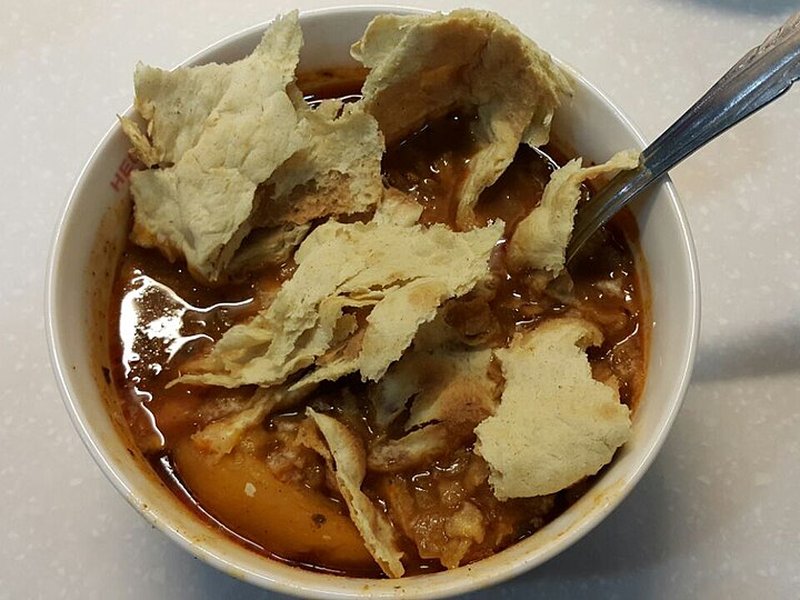
Tear the bread into pieces.
17
Arrange the bread in the bottom of the serving bowls and pour the stew with its sauce over it.
Serving bowlLadle
585calories
39 gprotein
52 gcarbs
23 gfat
● protein 27%● carbs 37%● fat 36%
Per serving, servings (calculated for this version)
A button hides that part of the recipe, in print too. Another click brings it back. The choice is kept for this recipe.
⚖ About the ingredients
Onion: measured in pieces: one ≈ 117 g · 40 kcal per 100 g · More about Onion →
Garlic: measured in pieces: one ≈ 5 g · 149 kcal per 100 g · More about Garlic →
Olive oil: measured in tbsp in this recipe: 1 tbsp = 14 g · 884 kcal per 100 g · More about Olive oil →
Stove· 💡 Workaround, changes the dish: Portable hot plate (one weaker burner) · Camping gas stove (One burner, outdoors) · Electric pressure cooker (multicooker) (One pot, no real shallow frying)