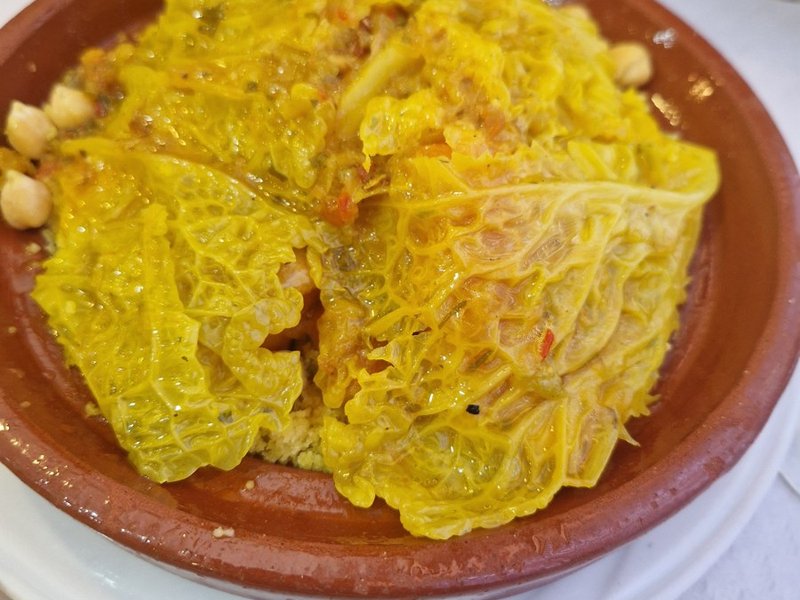
Moroccan Couscous with Savoy Cabbage and Chickpeas in a Tagine with homemade cooked chickpeas and homemade vegetable stock
Savoy cabbage slowly cooked in a saffron and turmeric sauce until soft and slightly sweet, covering a mound of couscous and chickpeas like a blanket. In Moroccan homes cabbage like this is served alongside the Friday night couscous.
Soak the chickpeas overnight in plenty of cold water.
Bowl
💡Soak in plenty of water, well above what's being soaked: legumes and grains swell and drink water, and whatever sticks out stays hard. Drain well before continuing.
2
Drain, cover with plenty of unsalted water and cook 1.5–2 hours, skimming off the foam and skins from time to time, until the chickpeas are very soft and crush easily between your fingers.
ColanderStovePot
💡Fully cooked chickpeas crush between your fingers with no resistance at all. Chickpeas that stay a little firm make a grainy spread, and no amount of tahini will fix it.
3
Drain, reserving a cup of the cooking liquid.
Colander
For the Fried onion
4
Heat the olive oil in a wide pot over medium heat.
StoveWide, shallow pot
5
Add the onion and fry 5–8 minutes, stirring now and then, until the onion is soft and translucent and starts to turn golden at the edges. If it browns too fast, lower the heat.
Stove
💡Add by cooking time: what needs long (onion, carrot, meat) goes in first, and what burns fast (garlic, dry spices) goes in last, only until fragrant.
6
Add the pepper and fry about 10 minutes, stirring, until it softens.
Stove
To assemble
7
Ahead of time, separate 10 large whole leaves from the cabbage, and cut the rest into strips.
KnifeCutting board
8
Cook the whole leaves in boiling salted water 3 minutes, until they are soft and pliable, and drain.
StovePotColander
💡The water should taste like a seasoned soup, not like sea water: a heaping teaspoon of salt per liter. Add the salt once the water is boiling.
9
Add the garlic, turmeric, paprika, ginger, cinnamon, chili pepper and salt and stir.
10
Add the tomatoes and cook 5 minutes.
Stove
11
Put the onion, carrot, celery, parsley, garlic, bay leaves and thyme in a large pot with the cold water.
Large pot
💡Start with cold water: the vegetables release their flavor slowly as the water heats up.
12
Bring to a boil over high heat and skim off the foam.
Stove
13
Turn down to medium-low heat and simmer uncovered 30–45 minutes.
Stove
💡A gentle simmer, not a boil: a hard boil dries the food out and clouds it, a slow simmer cooks it evenly.
14
Strain the stock through a fine sieve.
Fine sieve
15
Add the cabbage, stock, saffron with its soaking water and chickpeas and bring to a boil.
Stove
16
Turn down the heat, cover and simmer 20 minutes.
StoveLid
17
Lay the whole leaves on top of the stew, cover and cook another 5 minutes, until they take on the color of the sauce.
StoveLid
18
Bring the liquid, oil and salt to a boil and pour it over the couscous.
StoveSmall saucepan
19
Cover 5 minutes and fluff the grains with a fork.
💡Fluff with a fork, not a spoon: a fork separates the grains, and a spoon mashes them into clumps.
20
Serve a mound of couscous, the stew on top and the whole leaves over everything, and pour a few spoonfuls of sauce over the top.
21
Sprinkle the cilantro on top.
640calories
19 gprotein
88 gcarbs
19 gfat
● protein 13%● carbs 59%● fat 28%
Per serving, servings (calculated for this version)
A button hides that part of the recipe, in print too. Another click brings it back. The choice is kept for this recipe.
⚖ About the ingredients
Onion: measured in pieces: one ≈ 117 g · 40 kcal per 100 g · More about Onion →
Stove· 💡 Workaround, changes the dish: Portable hot plate (one weaker burner) · Camping gas stove (One burner, outdoors) · Electric pressure cooker (multicooker) (One pot, no real shallow frying)